STAGE 5 – (K+L+M+N)
(The Caretaker on Stage 5)
Post-Awareness Stage 5 confusions and horror.
More extreme entanglements, repetition and rupture can give way to calmer moments. The unfamiliar may sound and feel familiar.
Time is often spent only in the moment leading to isolation.
Album Cover – Stage 5
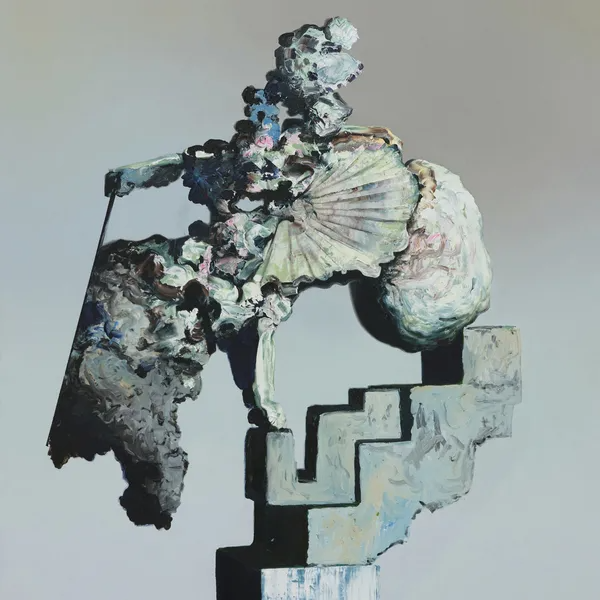
An abstract painting of what may be a representation of a clay sculpture. This painting is hardly recognizable as anything, with no sense of familiarity at all. Cover art for Stage 5, imagined and painted by Ivan Seal.
The cover of Stage 5 feels like a very accurate portrayal of the music. I often found myself unable to focus on any one sound before it changed, which is the same feeling I get when I look at this album cover. It is definitely the most abstract of the six covers, which makes sense considering the fifth stage feels the most abstract of all of them.
There are some shapes in this painting that seem slightly recognizable, such as stairs, a seashell, and a vaguely human figure. This may have been done to represent how in the late stages of dementia, a patient may fixate on objects they recognize in order to hold onto that aspect of their memory.
Waveforms and Song Analysis – Stage 5
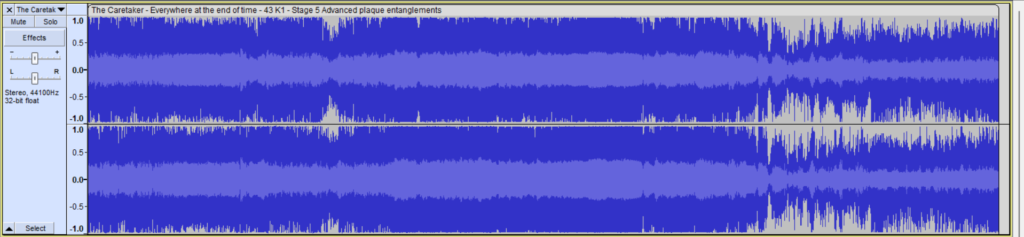
Immediate change from Stage 4. Everything becomes louder, and notes stop and start in a similar manner to the last stage. Voices can be heard on the right side of the listener. Birds, or perhaps a whistle, plays on the left side for a moment. At the same time, short samples of instrumental music play on and off in front of the listener.
Nothing is recognizable at all. No noise or music stays long enough for the listener to be able to determine what any of it means, or where it originated. There is little to no consistency in this track.
Then, there is a brief interlude where the different noises calm down. Crackling static noises become much more prominent, and an echoed melody plays.
The pattern from the beginning returns.
These two patterns- the cacophony of noise and the interlude- alternate interchangeably for the rest of the track, becoming more twisted, dark and corrupted over time. The interlude, especially, gradually becomes less like music and more like a wailing sound gently heard over white noise and static. The wailing noise then calms down, leaving a soft ringing.
Near the end of the track, some of the echoed cave-sounding noises from before can be heard again. Then the voices return on the right side, still unrecognizable. The track closes with a melancholy-sounding music sample, greatly slowed and inconsistently playing as the static rings in the background.
The tone of this track is very exhausting and tiring. The listener finds themselves needing a break from the constantly changing patterns of noise and music, and there is never a long-lasting sense of calm.
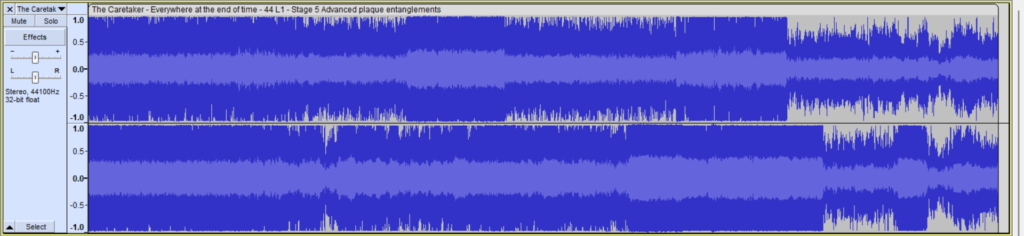
Begins suddenly. The music certainly sounds as if it were entangled, and each note that starts and stops is a representation of tangled memories all playing at the same time, back and forth in a manner that leaves no processing time for the listener.
Music begins after a while, sped up and warped beyond recognition. Once it fades away, static returns, and a similar pattern to the cacophony of noise from K1 begins.
This is nearly indescribable, as it creates such feelings of unease, confusion and horror that it is hard to decipher exactly what is happening. Static begins playing in the listener’s left ear, continuously on and off. This is then reflected on the right side, and the two patterns of static go in and out of sync, changing in speed.
Soon, the indecipherable music sample begins to play beside the static, then stops. Noise similar to slowed church bells ring in the background of the constantly changing static.
The tone of this track is incredibly scary. Stage 5 feels like the climax of Everywhere, as it largely consists of action, rapidly alternating patterns and confusing noise.
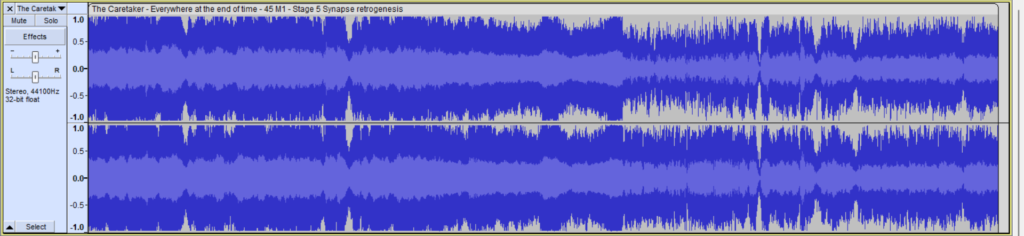
Static stops alternating, and becomes less noticeable. A new slower, calming music track plays in the background, behind white noise. The white noise then calms down, leaving only the relaxing music.
I feel as if I am floating in an empty void.
Every so often, noises that are not a part of the main track play softly, on and off. This happens more frequently as the track continues.
Around halfway through this track, a noticeable crackling noise, with distorted music behind it, begins playing, breaking the silence. More distorted noises pick up on all sides of the listener, disturbing the brief moment of peace.
Soon, a similar pattern to K1 begins, with noises which stop and start rapidly. Static switches between each side of the listener’s head, growing louder and quieter randomly.
Occasionally, the noise is vaguely recognizable as music samples from earlier in the project, although these samples never play long enough to identify. Only occasional notes of this kind can be heard.
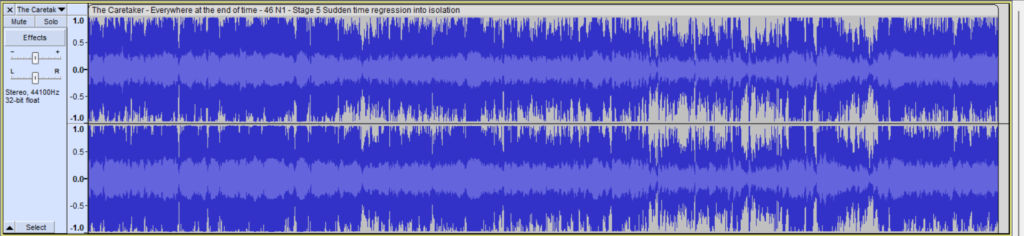
The transition into this track is identified by a sudden rise in high-pitched static.
The notes from before have largely become different forms of white noise. Some of them sound like a heavy wind, some sound like rainfall, and some sound like TV static.
After the initial confusion from switching tracks, the different forms of white noise begin playing in the same pattern as earlier tracks- on and off at random intervals.
The switching between statics is not as alarming as the random notes, as it feels more relaxed. This pattern continues for several minutes.
Eventually, a piano tune, warped and occasionally reversed, plays and rises in volume This melody stops and starts as well. There is a menacing dark white noise playing behind it.
Then, everything fades away for a second before coming back. This occurs several times, where it seems like the quiet is nestling in, before everything is back to the distorted form from before.
The white noise and static both become quieter, and noises do not switch as often. It seems like things are calming down a bit, although they will never be close to normal. This feels like the “isolation” the title is referring to.
Stage 5 Conclusions
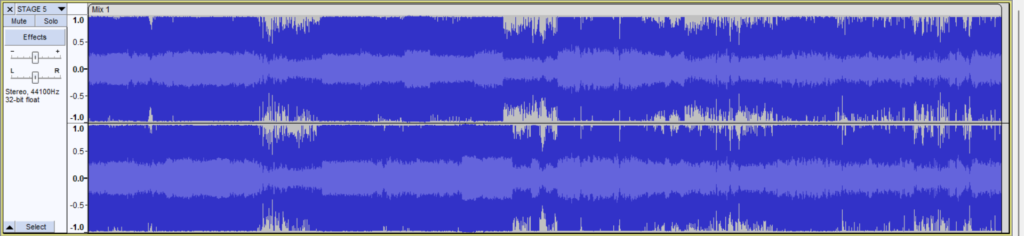
Stage 5 is incredibly loud and upsetting throughout. The large volume can be seen clearly in the waveform visualization, where the volume is almost entirely peaked at 1.0. Additionally, the tracks in Stage 5 are much longer and more disturbing than Stage 4. There are a lot of sounds occurring at once, making it difficult to focus on any one noise or effect. There is much less consistency in the category of sound compared to other stages of the project.
However, some familiar themes pop up between tracks, such as the alternation between white noise and rapidly changing notes. This could be considered the “unfamiliar becoming familiar” that Leyland Kirby mentions in his description of Stage 5.
There are rarely any moments of calm in this stage. Patterns keep changing and warping beyond recognition, leaving the listener to struggle to keep up with the changes. The beginning of “Stage 5 Synapse retrogenesis” is the most pleasant-sounding section of the album, as it consists of a calming music track behind white noise.
If Stage 4 was the beginning of a panic attack, Stage 5 is the climax. It almost feels like the climax of the project itself, especially in the first two tracks of the stage. There is always so much happening in this stage, whether it is changes in the white noise, alternating patterns of wild, inconsistent noise, or a loud static noise that is constantly grating at the back of the listener’s mind.