STAGE 2 – (C+D)
The second stage is the self realisation and awareness that something is wrong with a refusal to accept that. More effort is made to remember so memories can be more long form with a little more deterioration in quality. The overall personal mood is generally lower than the first stage and at a point before confusion starts setting in.
(The Caretaker on Stage 2)
Album Cover – Stage 2
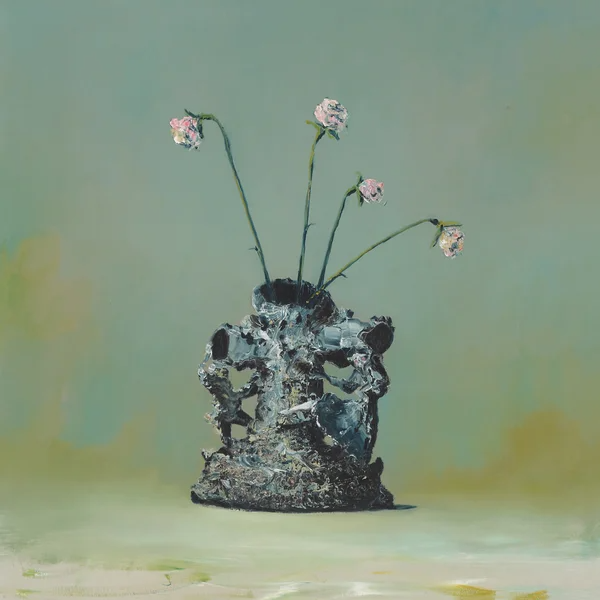
The holes in the vase on this cover could quite literally be interpreted as “holes in memory”. As a patient finds themselves taking more time to fully remember old experiences, they may feel as though their memory is “decaying”, much like the vase and flowers in the painting.
These flowers could also represent old, dying memories struggling to survive in a slowly deteriorating mind.
Waveforms and Song Analysis – Stage 2
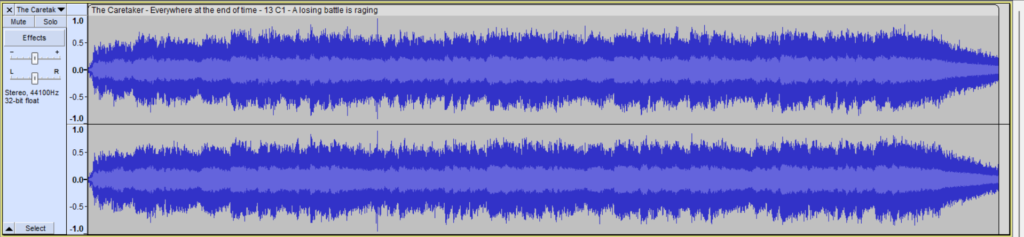
The static has changed. It’s louder, it’s blocking out more noise. There’s more mechanical noise as well. Waking up in a hospital, confused.
The static vaguely sounds like someone washing their hands- it’s a constant, strange rushing sound.
There is still background music, but it’s much harder to hear. Something is wrong.
Everyone is smiling around you and looking at you, but why? Why do they look sad? Why can’t you hear what they’re saying to each other? To you? Is it something you did wrong?
Confusion. Anxiety. Heartache.
The song itself is sad. It sounds like something that would play in the background of an old movie, or at a funeral as the casket is being lowered.
The music fades away on one last, extended note as the static calms down for a second.
Then silence.
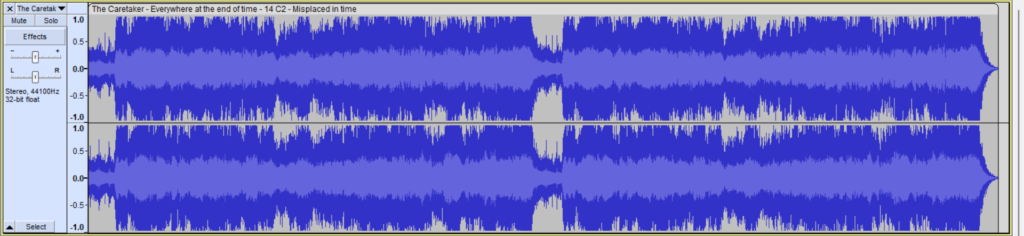
Abrupt start. Static returns. Mourning. The muted trumpet makes it sound like a wild west film. Alone and afraid. There’s a great danger lying in wait ahead of you. All you can do is continue forward in a dejected haze.
The sun has clouded over. You are walking through a confused fog. You cannot tell where you are or how you got here, but you know you are helpless to do anything to change your fate.
Depression. Confusion deepens. Suspense. Resignation.
Repeated, spooky melody. Dissonance between staccato and legato notes creates a sense of fear.
Ends as the music crackles and breaks, and stops with an extended echo of the last hit onto the piano keys.
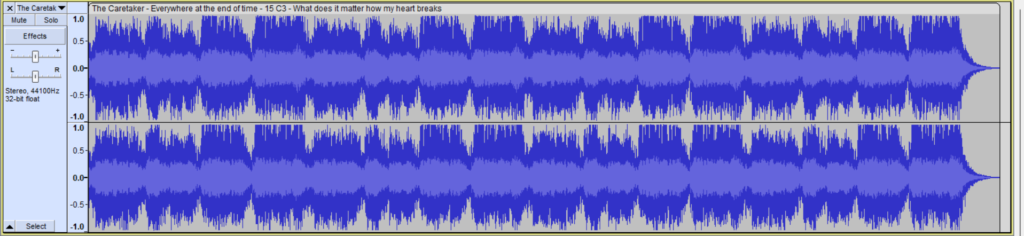
Sounds very similar to the very first song of the project, but with different instruments. It’s almost as if the same melody was recreated years later by a dejected composer.
Chilling. Haunting. Deja vu.
Slower, more echoing, lower.
Ends with an echoed trombone note.
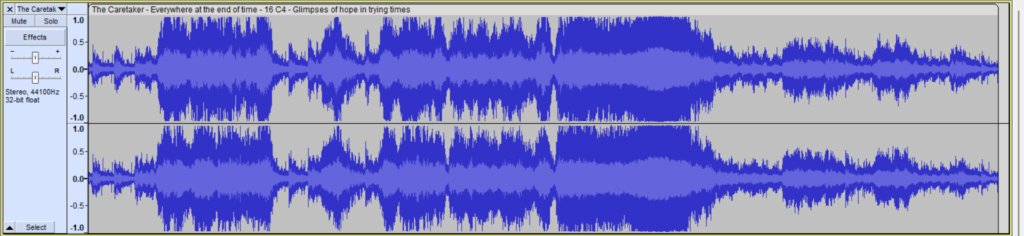
Begins slowly with a light, tingling noise that repeats a few times. Like a machine. Hooked up to something?
Then the other instruments come in. Mystery. “What is going on, why are things changing?” Reminds me of a snake charmer melody in a way.
Return of suspense. Darkness. A pit in your stomach that won’t go away.
How did things turn out this way?
Then the melody soars and returns. Even if things are unclear for now, that doesn’t mean it will stay that way forever.
Reminds me of the sound of an old horror movie playing in the next room.
Fades away slowly in the middle.
This feels like a professional symphony. A song composed for a horror film, where each new melody represents something changing in the room.
Feels somehow like a haunted mansion.
Ends as the music slowly fades out. Decrescendo. A final note.
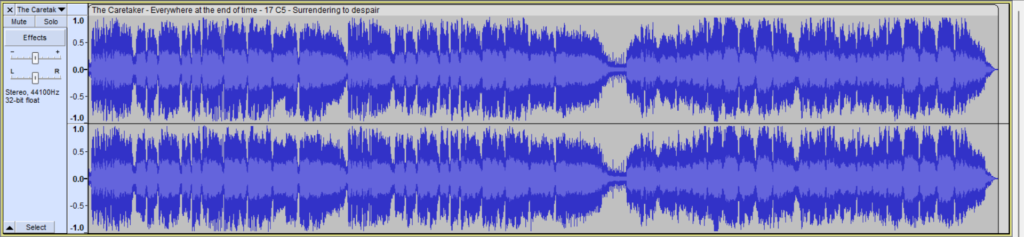
Static changes forms once again and the music begins.
True feeling of helplessness. Things will never be the same as they were.
Footsteps approaching and leaving multiple times throughout the track.
Laying in a hospital bed staring at the wall.
Bored. Tired. Wanting to rest. Alone.
The footsteps become more crunchy as the audio continues. Soon, they feel like they’ve always been there.
The music cuts out at one point, only leaving the footsteps. Then it comes back in, lower and more resigned. Deep noise.
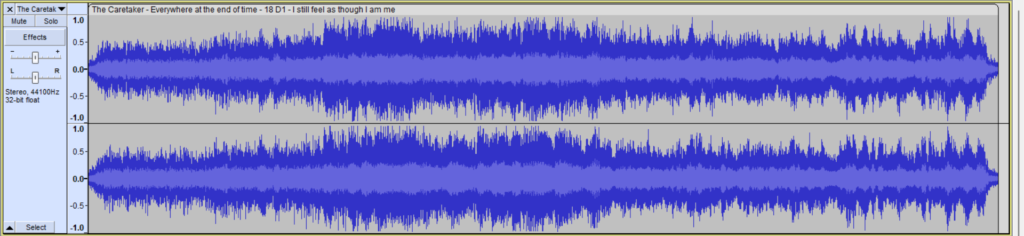
When this track begins, the mood shifts entirely.
Dark clouds rolling in. There is no turning back at this point.
The strings make it seem a little lighter, but they also add to the chaos. Something is very wrong. This is not the same music The Caretaker used to dance to. This is more frantic, scattered, darker, more depressing.
Deep breaths in and out, as you try to find that quiet place inside of your mind that will keep you safe.
Ending is confusing. Slow fade-out of the music itself as the static continues.
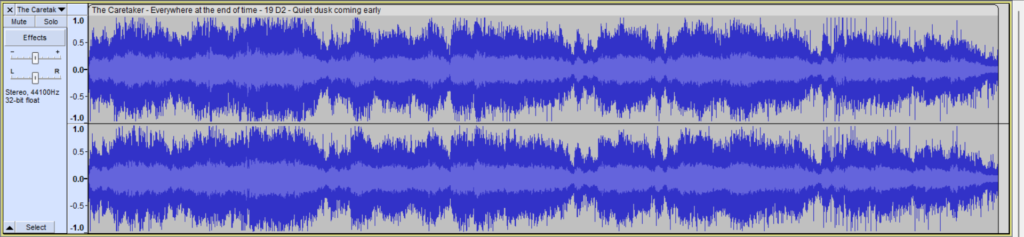
Static becomes louder.
Music feels just a bit lighter. It feels home-y. Reflective.
When I listen to this I imagine sitting in an old armchair in the living room, the fireplace turned on, rocking back and forth. Cozy and warm. Your brain becomes just a bit quieter as you try to focus on the music and tune out the static in your head.
This track just feels romantic and warm.
The transition into D3 is not too startling, as the music naturally concludes and paves the way for the next track to start.
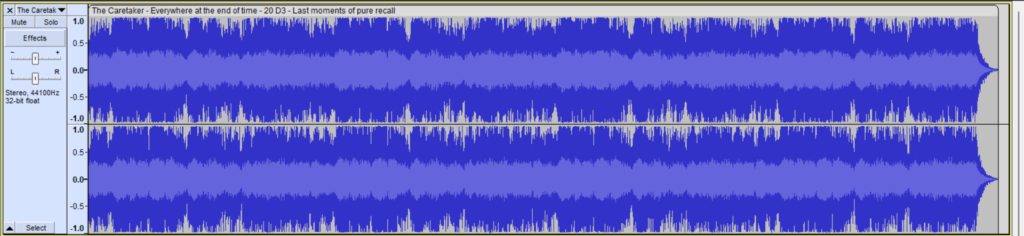
Right away, this track feels a bit darker than D2. It feels like you’re trying to stay positive and ignore what’s happening around you, even though you know the darkness is coming.
However, the static has largely let up in this track, leaving a purer, clear sound.
This feels like a love song. Perhaps it is meant to be a final reminiscence of a love that is long past.
The song fades out as if it disappeared. Suddenly the ability to clearly recall your past is gone.
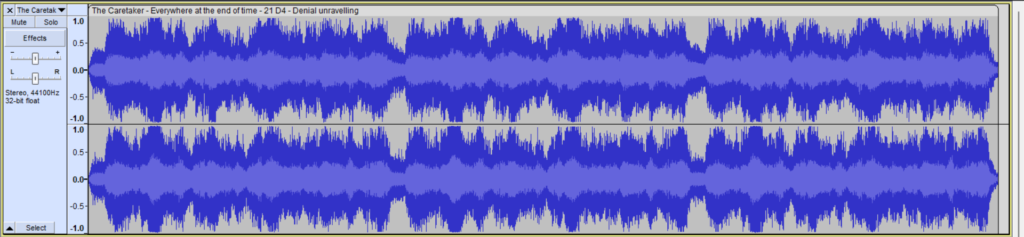
This track fades in after a few moments of silence. In the beginning, the notes increase in pitch as if going up a musical scale, and it is very anxiety-inducing. It’s like the thoughts in your head start getting louder.
This track feels like you’re sitting on a train that’s about to go off the rails.
The slow acceptance of your doom as you realize it has become too big to deny anymore.
The repetitive melody is also anxiety-inducing. It feels like the end of a movie where the protagonist died.
D4 fades out in a similar fashion to D3, albeit a bit faster.
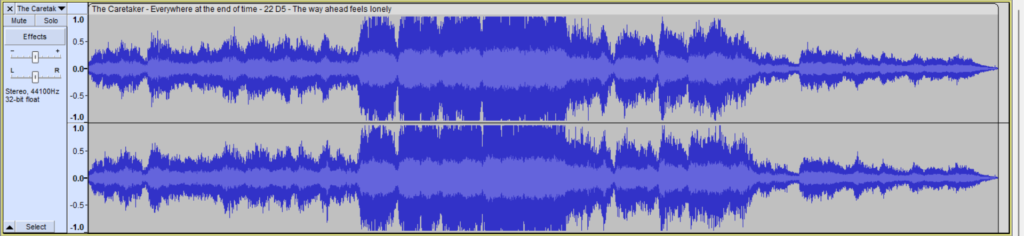
The fade-out in D4 is cut off when this track begins.
This track definitely does feel lonely. Very melancholy; almost feels like a lamentation.
A lot of falling scales, which makes it all the more depressing. Much longer, legato notes.
Almost no static. The sound itself is muffled, but it is mainly uninterrupted.
It also feels kind-of devious in a way. This track would play in a children’s movie while the villain is creating their lighthearted plot.
A bit of static can be heard at the end as the music fades out.
Stage 2 Conclusions
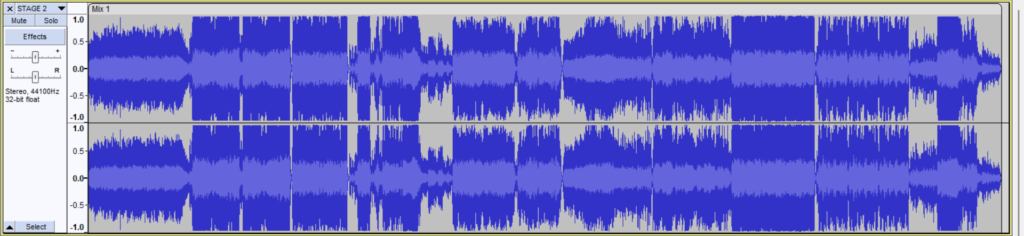
Immediately, this visualization shows how much variation there is in volume throughout the stage. Each track can be easily identified, as well as the silences between them. Additionally, some tracks crescendo and decrescendo in volume, which is a clear change from Stage 1, which stayed nearly the same volume throughout.
Here, Kirby greatly increases the volume and prevalence of static behind the musical tracks. Static is a very important part of Everywhere, as it is one of the main additions Kirby has made to the music he sampled.
In Stage 2, the static creates a sense of cloudiness and uncertainty, almost as if the brain recognizes that something is wrong but refuses to acknowledge it. However, some tracks in this stage have little to no static behind them at all. This may represent temporary moments of lucidity in The Caretaker, where they are able to focus well enough to recall memories fairly well.
However, even in these moments of lucidity, the mood of Stage 2 creates feelings of unease and anxiety in the listener. This is where confusion begins. The brain attempts to convince itself that it is working as normal, although it is clearly expending more effort to recognize patterns and remain in a stable state of mind.